

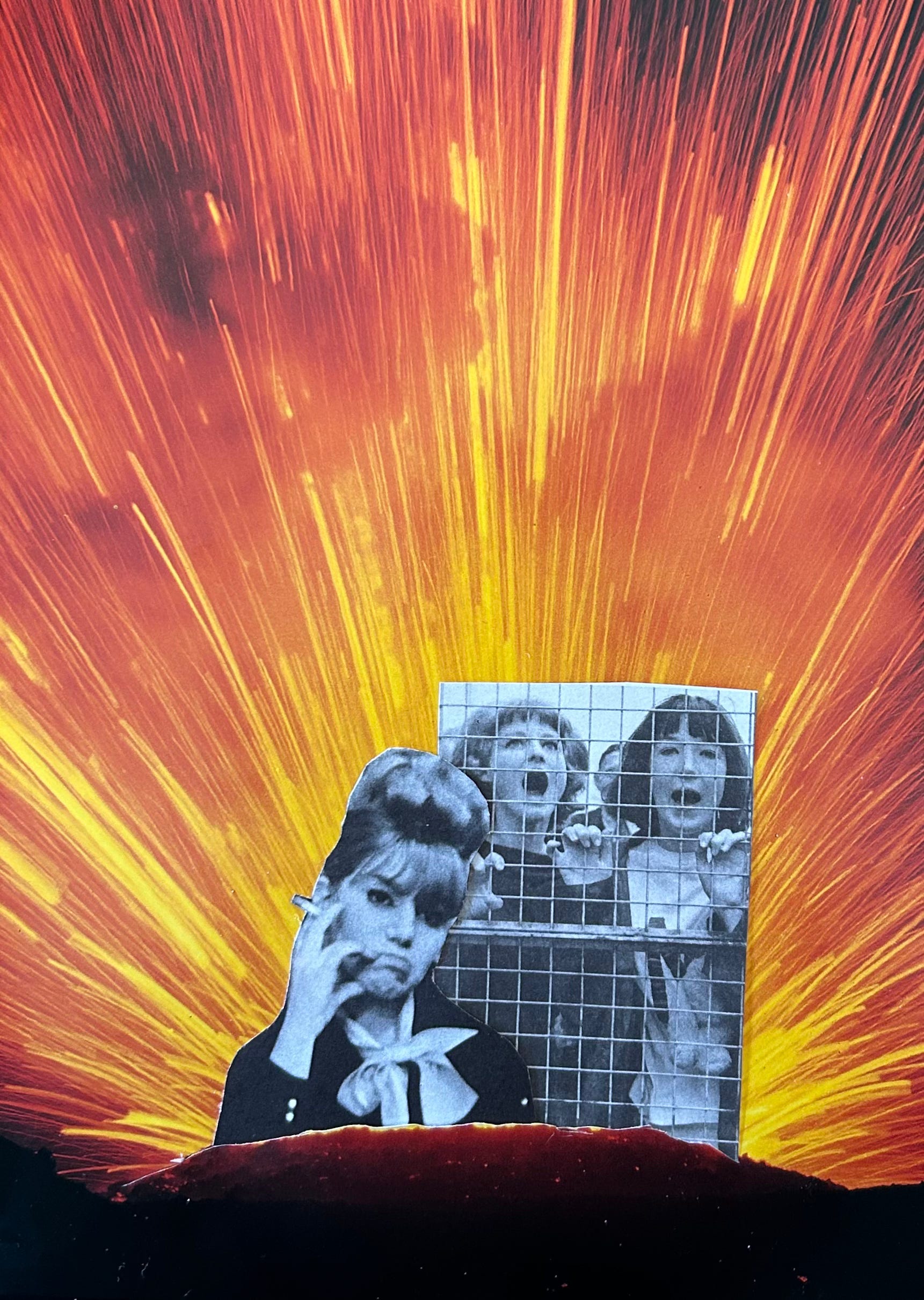
Do you know the feeling, when your chest is about to explode from not acting? The inability to go where you want, get what you want. You just know you’re stuck.
In my early twenties, I tried to ghost a guy. It was around the turn of the millennia, and my excuse is I was young and living abroad. Back then it was an established fact that abroad didn’t count. He was tall, good bone structure, blue eyes and a full head of unruly, dark hair. He worked in TV and had just been involved in making a documentary that was getting modest attention. In short, he was perfect. We had been on some dates, there had been kissing involved, he had written me a funny poem. And I just wasn’t feeling it. I think I was vaguely embarrassed by the fact that I had no reason to not see him anymore. Except. There was no spark. So I decided to passively let it peter out. I did my best to avoid him for a few days, but in the end I picked up when he called my land line. At this point it was obvious what I was trying to do, and he angrily confronted me. He told me exactly what he thought of my behaviour, that not telling him we were done was a shitty thing to do. He got to let his angry, hurt feelings out, and I had to face the consequence of treating him badly. It was embarrassing, uncomfortable, and well deserved. And it’s becoming increasingly rare. This was before therapy-speak entered mainstream consciousness. Back then, things ended.
These days everyone is working on themselves, have set healthy boundaries, understood their triggers and landed in a good place. Or so they say. Ask anyone and they will tell you they have been ghosted, or they’re in a situationship with no clear structure or boundary. If you never defined what you are to each other, can you ever rightfully be upset with them? Therapy-speak becomes a paralysis mechanism. The language of healing forecloses action, because acting would contradict the narrative of having already processed it. Processed what, exactly? If someone quietly disappears rather than breaks up with you, what are your feelings supposed to do? The practical reality is that without a clear ‘no’ from them, you’re left managing your own threshold. How long are you willing to wait, and what to do with the silence if it stretches. The performed healing becomes a sophisticated form of avoiding accountability, for everyone. All doors and windows left ajar, waffling positioned as a power move. And inevitably they circle back. When no one is close enough for uncomfortable confrontation, but never further away than a click, the threshold to reengage is as low as your current level of boredom. None of this was possible when geography made confrontation inevitable.
When they return with “I’ve been doing a lot of work on myself” your anger is pre-empted before you can even unleash it. Will Smith’s post-Oscars processing tour is the clearest recent public example. He lost it over a joke made at his wife’s expense. The language of “healing journey” and “doing the work” was subsequently used to reframe an act of violence as a psychological event happening inside him, which effectively made his feelings the subject and deflected the accountability question entirely. Converting the narrative to focus on his personal growth pre-empted any anger others were entitled to feel.
Will Smith lost control, briefly exposing what we’ve been trying to hide since the ironic generation perfected the art of complete detachment. No one is losing control anymore. The last unoptimised space, the body in free motion, sweating, inefficient, has been captured, ticketed, made functional, as Gen Z started engaging in coffee house clubbing and kettlebell raves. Instead of out-of-control dancing at night clubs, they’re dancing while drinking coffee in daylight, or rave while simultaneously hydrating and getting their daily workout. For someone who used to go out with the motto “it doesn’t matter you can’t tell in the dark” it’s hard to understand how any hookup under these circumstances doesn’t turn into a job interview. Maybe they bring their resumés to save time. Embodied appetite is repackaged as aspirational replication. You sweat, but productively. Desire is rebranded as virtue, your need for bodily contact becomes an optimisation project.
Self-optimisation is the new emotional detachment. We work to become self-assured, well- adjusted, evolved, and self-contained. Effectively, we’re trying manage our emotions to fit the image of the perfected individual. Harmonious and in need of no one. It’s aspirational replication of an image with no one behind it. Mindfulness. Nervous system regulation. Tradwifing. Looksmaxxing. Let them. Yung Lean in Storm II, battered, smoking, stoic, standing still as chaos erupts around him. Not managing it, not performing alongside it, just absorbing it.
We want raw, unfiltered emotions again. Cigarettes, smeared makeup, friction, sweaty bodies. Sex. But intimacy is difficult. The other person makes you angry, as well as horny and happy and sad. Our aspirational optimisation has paralyzed us, but we need somewhere for our anger to go. You can’t act on real emotions from inside an image you’re trying to become, you can only perform. You don’t explode. It gets managed, processed, contained. But the feeling is still there.
Like a tight compression on your chest and throat, threatening to explode.