

Opening the Archive
In February, Maison Margiela announced the launch of the ‘MaisonMargiela/folders’, a multi-layered project that includes a runway show in Shanghai, a series of exhibitions across China, and an open-to-all digital archive called the Maison Margiela Dropbox. In essence, the fashion house is making their archive public, allowing any and all to use its research for upcoming projects, and view their internal imagery and the house’s archival material dating back to its founding in 1988. The news has so many implications it’s hard to know where to start. The most obvious is the archive itself. You can now access not only the finished pieces, but the work in process and visuals that never made it to the runway. An actual archive. Actually open. Anyone can look, no purchase required. No “archival-inspired” hedging.
This is huge, especially if you’re an aspiring designer. But what they are doing is even more genius. At ‘Bianchetto: Atelier Experience’ in Shenzhen in April, they are inviting guests to bring their own garments. According to their own IG: “Participants are invited to transform an item from their own wardrobe using the technique, guided by the Maison Margiela Atelier team. Through the act of covering the surface in white paint, the piece is transformed into a house code, completed with our signature four white stitches.” And in Chengdu you can see “Tabi: Collectors exhibit”. Again, from their IG: “exhibition brings together the personal collections of 9 Tabi collectors from around the world for the first time, offering an intimate look at how the silhouette is lived with through a full-scale reconstruction of each collector’s wardrobe.”
Not only are they inviting you to see their archive, they are inviting you to collaborate with it, build on it, and become a part of it. It ceased being about appreciating fashion design and became living the brand in real time. Honouring the long-time fans of the controversial Tabi-shoe is a particularly sharp move. You’re either a die-hard fan or you hate it, and collecting it bears no comparison to collecting Birkins. The Tabi-wearer is a connoisseur of fashion that thinks rather than signals, and the shoe’s shift from fashion statement to museum artifact marks the elevation of luxury from the expensive to the irreducible.
Re-authoring the archive
The timing is interesting. The new head designer at Margiela is Glenn Martens. He’s the second designer to take over since the famously anonymous Martin Margiela stepped down, and that’s where the new head of the house can start to decide what to pull from the archives and how to transform the brand into something potentially new, but still familiar. His predecessor of course, is the infamous John Galliano, and as Maison Margiela launched their actual archive, Zara announced that they signed Galliano to a two-year creative partnership which will see him “re-author” the brand’s archives.
So many synapses are firing simultaneously here, it’s almost poetic. After nearly 40 years in business, Margiela is trying to launch itself as a ‘heritage’ brand, and opening an archive and aligning their fashion to art is a good way to do it, it places them in a room with Schiaparelli, or Vivienne Westwood. Galliano on the other hand, is on his own tour de force redemption tour. After his 2011 scandal and rehab stint, he attempted a comeback that stalled. Most notably in 2013 he was denied becoming a workshop lecturer at Parsons. Renzo Rosso brought him to Margiela in 2014 where he worked in relative anonymity, until the SS 2024 Maison Margiela Artisanal show: “Galliano’s final show for Maison Margiela was a true masterpiece, befitting the artist he is. Held on Paris’s Alexandre III Bridge, the show merged the worlds of Balzac and Victor Hugo, making it one of the most impactful fashion presentations of the past decade.” With a bang, he was back on everyone’s mind, but not for spouting antisemitic slurs. For being a true artist. The documentary “High & Low: John Galliano” released in the same year essentially ran in parallel to the show, possibly as a coordinated rehabilitation moment. One cultural, one commercial. What would he do now? Dior and Chanel were name-dropped, but nothing happened.
Then along came Zara, with their own mission of repositioning themselves away from their fast-fashion cheap past, toward a more luxury and fashion forward brand. What better way to do this, then by creating an archive, and then start pulling from it. The memes featuring Galliano pulling at massive dump sites could have meant backlash, but they exist in a landscape filled with slopaganda. It won’t stop customers lining up for the first collaboration. Galliano is using Zara as a platform to showcase the best bits from his own archive, while his talent archive is being monetised through Zara. This is curation as extraction. The radical and transgressive gets laundered into product, stripped of context, made safe and saleable.
The curated wardrobe
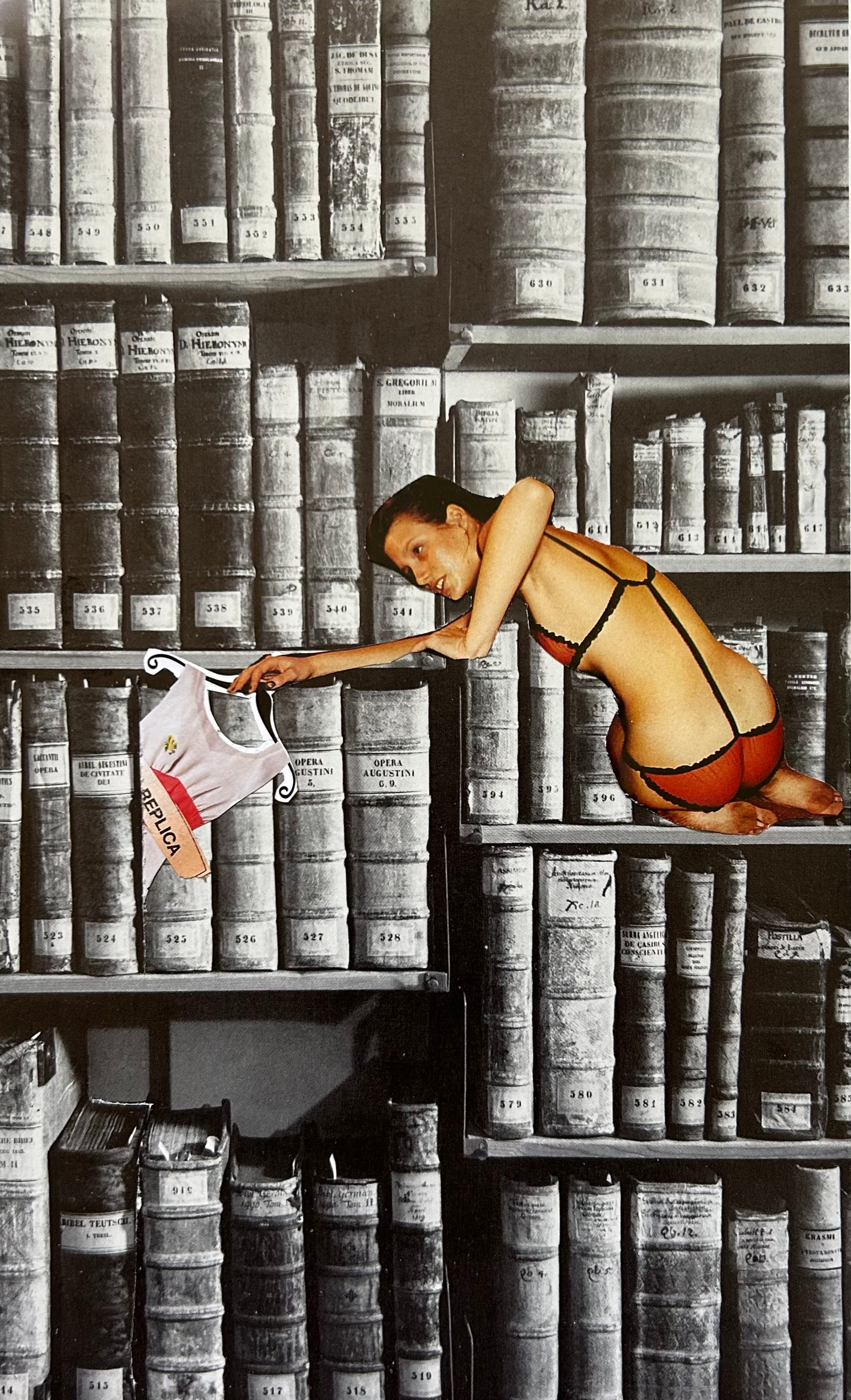
We keep circulating back to the word. Archive. And with it, its logical companion, the curator. Curation started as a profession at museums or actual archives, but the word got democratised into a lifestyle act, and nowhere is that more visible than on the movie press tour circuit.
Recently we had the pleasure of watching the show ‘Margot Robbie on Press Tour’. She was promoting Wuthering Heights in outfits that had been chosen specifically to fit the mood in the film. Leaning heavily on Victorian elements and Baroque opulence, with a dark romantic twist, her stylist curated her outfits as a mix of custom looks and vintage pieces. For example, a look from Galliano’s 1992 spring collection. Promoting a movie famously about repression, buried feeling, and what gets exhumed, she wore a designer whose own archive needed rehabilitation before it could be worn in public again.
Celebrities have been pulling archive looks for a while, but the increased attention paid to the stylist and the context of the look has brought the concept front and center. Instead of buying a second-hand shirt or choosing an outfit for the day, we are curating our wardrobes and sourcing archives by buying vintage pieces. Buying new clothes can be justified as adding to a collection, like the Tabi-shoe superfans on exhibit in Chengdu. Words that used to mean something specific have been hollowed out by marketing until they mean nothing except “expensive” or “tasteful” or “not fast fashion but also not explaining why”. They are doing the work of making consumption feel like restraint, or intelligence, or even resistance. But they’re still just selling you things. And we buy it, since the promise of a vintage archive to pull from elevates our own image to that of being curated by insider knowledge, not just thrown together on a whim and a budget.
Wearing archive Galliano right now is itself a curatorial act with a position embedded in it. It says the work can be separated from the man, or that enough time has passed, or that the rehabilitation was sufficient. The house of Lagerfeld is quietly doing the same, burying his misogyny and his notorious views on fat people and immigrants, instead showering us with acclaim to his artistic accolades. The fashion industry suppresses its ugly archive and markets the suppression as connoisseurship. Then turns to women and says: do the same. Present only the worthy. Edit out the messy. A curated wardrobe, a curated feed, a curated life.
Curating the self
While we may be aware of our very conscious attempt of curating an outer image, most of us would rather not admit we do the same with our actual person. We are attractive and absurd, enticing and repulsive, but just like the fashion industry, we curate carefully what gets to be pulled out and what remains hidden. The raw and uncomfortable need never see the light of day.
The archive doesn’t lie, even when you’d prefer it did. I recently found two old texts I wrote at 21 or 22, after being dumped by my first big love. The breakup turned me into a needy basket-case, and I poured my heart out onto those pages. It was all melodrama and existential angst and I never showed them to anybody. When someone leaves you, you want to rise post haste like a phoenix, untouched. Not drag it out with months of crying and clinging. We would like that buried in the archives forever. And we’re loath to admit that an ex helped curate our personality.
Those were the last pieces I wrote until a surprising burst of creativity made me write again, some 26 years later. I didn’t stop writing entirely, I went private, underground. Which is its own kind of archive, one I kept for myself, that nobody else could read or take or misunderstand. Or leave. The messy original didn’t need to be curated into the shareable version. Sometimes mundane, sometimes unravelling, navel-gazing, regurgitating. Sometimes concise lists. Sometimes nothing. Journaling as a practice kept something alive without exposure or collaboration.
My first essay in twenty-six years was 90s Bitch. Fashion criticism, but also, a piece about bodies and desire and what gets taken from women and what they reclaim. Heartbreak melodrama was the thing that closed the door, and anger, specifically anger about how women are seen and consumed, was the thing that opened it again. The eruption, after years of moderation. Something had been missing and I thought it was something external. Desirability. The relentless ageing that brings you further away from relevance. When someone suddenly flirted with me I thought this is it, I needed to feel chosen. But that feeling threw me right back to my 21 year old self, moulding my personality to be its most interesting, alluring, captivating, hiding the boring bits, the replaceable parts. I was again curating myself to best fit the room I was in.
For something to be vintage means time passed and it survived. You pair it with something contemporary and create something new. The difference between me now and then is a life lived and experiences made. As with any archive it’s a collaboration of the content and the person engaging with it. I didn’t miss being seen, I missed being the one who creates something that is seen. The writing is mine, and writing it makes me feel something.
Not the validation, the making.