

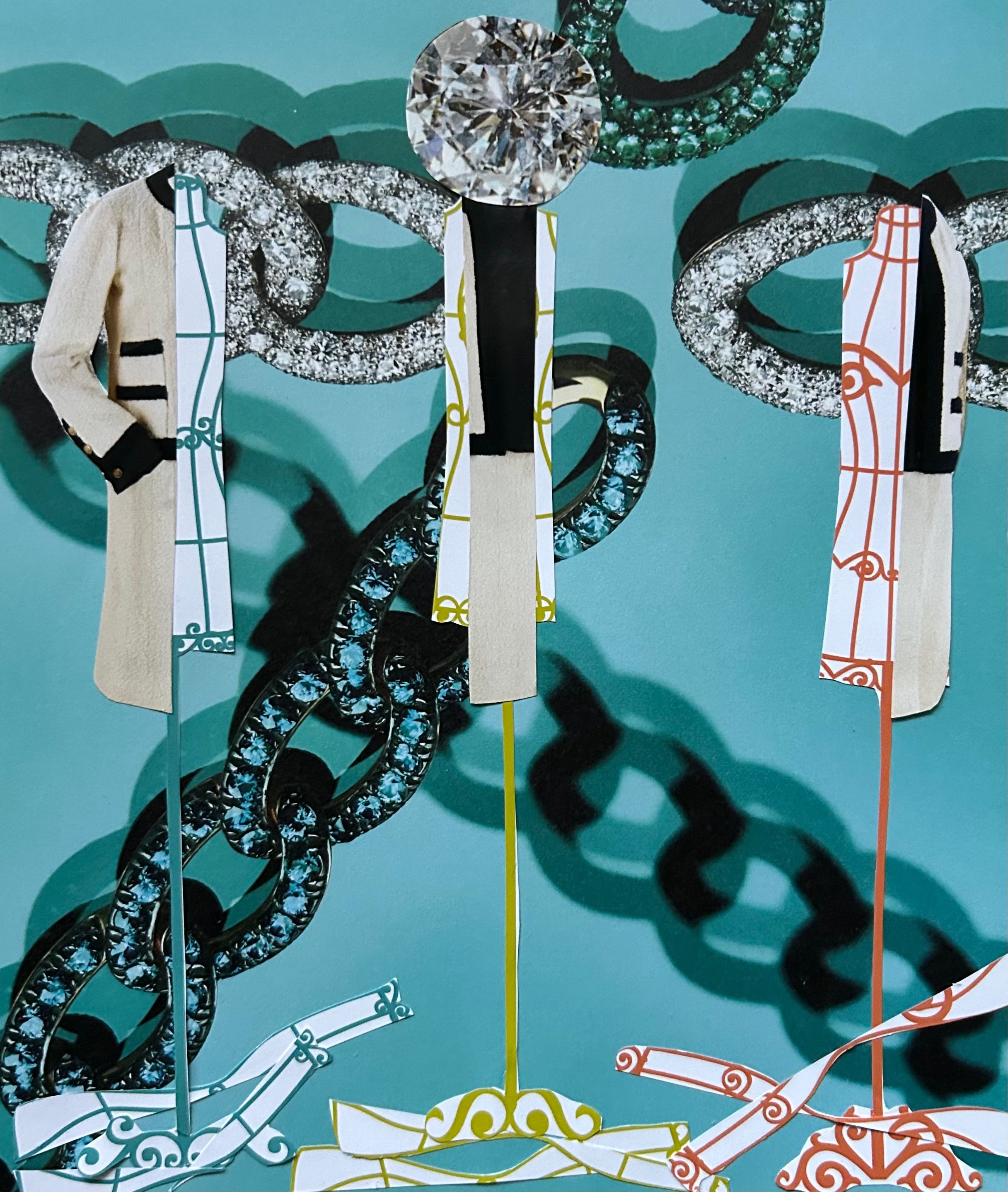
The couture shows have wrapped once again, and we just saw all the stars parade across the Oscar’s red carpet, done up real nice in mostly Louis Vuitton, Chanel and Dior. As someone who’s into fashion my algorithm is currently flooding me with luxury, and I’m experiencing a certain fatigue with feathers, lace, silk, and cheek bones. What even is luxury anymore? The God of Questionable Quotes Karl Lagerfeld told us already in 2010 that we’re delusional if we think buying a Chanel bag is luxury.
“People can dream with a Chanel bag that they live in luxury. But luxury in fact is something else.” — Karl Lagerfeld
Do you own a private jet? No? Then go back to your plebeian little life and stop pretending that your classic flap bag means you live in luxury. He said it, but we were too busy saving up for that bag to listen.
The fashion houses used to make a good profit catering to the aspirational shopper. You know, the ones who buy the ‘cheap’ high end luxury items (key rings, bag charms, wallets), or maybe they save up for The One Bag. They are NOT spending a million on Hermés furniture to be allowed to buy the croc Birkin in black. Over the past five years these fashion houses have steadily raised their prices and all but abandoned product development for the aspirational shopper. They are now wholeheartedly catering to the VICs, or Very Important Clients, who are the top 2% of customers who account for about 45% of global luxury sales. Or, to put it another way: Mrs Moneypants, who has a personal sales assistant on speed dial, probably arrived to the store with a driver, and gets all their purchases delivered to their home, because carrying a shopping bag is gauche.
The illusion created for us by aspirational luxury is made even more difficult to swallow under the blatant wealth we’re now surrounded by. There was always the ultra rich, and they always had their expensive, eccentric habits, but there was a time when extreme wealth was more of a rumour. Because we rarely saw it up close it remained a myth, or a cute anecdote. You heard about it, read about it occasionally in a magazine at the dentist, and then got on with your life. The distance was the point because it allowed the fantasy to function. The Chanel bag was a portal to a life you could almost imagine, if you squinted. Cue the rise of wealthy tech! Theirs is a wealth that few of us can wrap our heads around. As the extremely rich got extremely online, the fantasy soured. They rent a city to get married, order yachts so large you have to dismantle historic bridges to transport them to the sea, do space travel for the photo op, and spend millions every year to stave off death. Recently, they’re even man-spreading front row at fashion week. Quelle horreur! We watch it play out on the same screen we use to check our bank balance. The cognitive dissonance is spectacular, and it has broken something fundamental about aspirational luxury. You cannot feel elevated by a handbag when you’re still wearing it with your Zara shirt while flying commercial on vacation. The bag hasn’t changed, the context has made it absurd.
So, you ask yourself, what does this VIC look like? She’s thin, and most likely over the age of forty-five, or it’s her husband (who’s also shopping for his girlfriend). It makes total sense that skinny is the new luxury! While we have long gotten used to the female body being objectified and sexualised to satisfy male desires, it now seems it’s being monetised on a new level. The female body has become a class marker. Can you afford the luxury of staying thin and young? Even when the price for GLP1 injections is steadily decreasing, it’s still costly to keep up long term. And it’s not only the female body, it’s also her face. The new era of ‘longevity’ (that’s bs talk for eternal youth) sees women as young as their early thirties get deep plane face lifts, which start at about $20k but can cost upwards $100k. These procedures typically have to be repeated every 10 to 15 years, meaning a total investment of $100k to $500k over your lifetime, if you want to keep up. We all knew that wealth played a big role in ageing well, but that it would be this literal? Aside from your expenses on supplements, skin serums, GLP1s and a personal trainer, add your face lift to the cost estimate. And that’s before you bought the classic Chanel jacket in its updated see-thru version for CHF11.5k, and the see-thru top and skirt to match (add another CHF11k). At least you can deduct the cost of food, since you’re no longer hungry.
Did you think we were done? Bless your heart. Lately, apparently, small breasts have become known as ‘designer boobs’. It’s interesting how they went from representing the starved, indie body in heroin chic, juxtaposed to sex bombs like Pamela Andersen and Anna Nicole Smith, to signifying ultra luxury, but there it is. The current body trend is protruding bones: hip bones jutting out, collar bones standing erect (Schiaparelli made a gown with floating shoulder straps in 2024, that to me seemed to poke fun at the poking collar bones) and visible chest bones, topped by small, exclusive breasts. The recent fashion weeks cemented the fact that super skinny and flat-chested is in, with catwalks parading models thin as sticks up and down, week in, week out. Rumour has it some photographers complained that the moving thin models didn’t photograph well, apparently they were too thin to stick on film. Both Chanel and Dior, two ultra luxury fashion houses that are getting a lot of attention lately due to their changing of the guards (Matthieu Blazy coming to Chanel and Jonathan Anderson taking over Dior) presented silhouettes that can only be described as waif-ish and ethereal. The women, like their clothes, were practically see-thru. Blazy got a lot of positive attention for including older models in his couture show, but I’d like to point out that thinness still took center stage. Also, model Stephanie Cavalli is only 50 years old, and looks like a skinny 25 yo with grey highlights. That’s not inclusion, that’s bullshit! But we’ve long been calling size 8 (EU size 38-40) plus-sized, so we should be used to this level of absurdity.
All the big fashion houses realised that you need new clothes to show off your new figure, so they’re tailoring accordingly. Wisps of fabrics, fluttering around protruding bones (note that the body-con dress is out, since bloating is a common side effect of GLP1s). So is luxury affording that handbag? No. Luxury is being able to wrap yourself in Chanel-branded gauze when strutting down the street, your collarbones seeming floating off your shoulders. Also, spending thousands on pants, skirts, and dresses with hemlines dragging on the floor, so that every step you take is not only gorgeous, but also shredding your outfit. You are obviously both rich enough to not have to walk busy, dirty streets, and to not care that the outfit is ruined after three wears. Jonathan Anderson, in a recent interview, said
“It used to be that you would dress up for status purposes, now it’s more about the psychology, or what group you’re part of.”
Again, a designer who openly admits what it’s all about! Dressing for the group you (want to) belong to still is very much dressing up for status, and now that status is thin, young, and rich.
Since the launch of MTV, the majority of videos shown on the channel portrayed women as two-dimensional sex-objects, whose empowerment and sexuality was driven entirely with the aim to satisfy male desire. Butts wiggle, boobs jiggle, and even when the artist is female she’s often backed by male producers and record labels. The fashion industry is playing the same game. Women may be the target consumer, but the business is run by and large by men, in retail, on the designer side, and the media reporting it. But if the fashion houses are leaving the aspirational shopper in the dust, tailoring both their clothes and their prices to fit the ultra rich and ultra thin, why should we even care? Because, as was always the case with trends, it trickles down. All the way down to the kindergarten playground.
Little girls (and boys!) do not read Business of Fashion or follow couture week, but they are exquisitely attuned to the women around them (their mothers, their teachers, the older girls at school) and they absorb everything: the skipped lunches, the whispered comparisons and the creeping sense that a woman’s body is always a problem to be managed. They absorb the idea that taking up less space is something to aspire to. I recently overheard a third grader gleefully announce that her mother doesn’t eat breakfast, or lunch. She had no idea she was describing a tragedy. If the fashion industry and the wellness industry and the luxury industry are all pointing in the same direction (thin, young, expensive), then that is the direction the culture moves, and the culture does not stop at the gate to the playground.
The O.G. feminists were fighting for basic equal rights for women: the right to vote, work, sign their own rental contracts, and open their own bank accounts. Feminism these days seems to have boiled down to being able to pay for all our consumerism bullshit by ourselves. Don’t even get me started on the expectation that emancipated women pay 50/50 on dates, when it’s implicitly understood that they spend more on clothes, hair, makeup, nails and bikini wax (you never know where the evening might go) before even showing up. Women lived the more expensive lives even before society started tacitly implying we have face lifts at thirty-five. Healthcare, haircuts, shoes, clothes, sanitary products, it’s all more expensive for women, but women still earn less than men. Women are presupposed to pay more for clothes and makeup to merely look presentable in any situation, be it business or pleasure. Further, women often pay higher rents because they opt to live in safer neighbourhoods, and are more likely to take a taxi rather than use public transport, since they don’t feel safe on the streets.
When I was 16, an Argentinian boy told me that the high rate of anorexia in his country was due to a deliberate effort from the government to keep people’s minds on appearance, and thereby off politics. It was 1994, and a 16 year-old Kate Moss had recently cavorted topless on the beach for the cover and feature story of The Face magazine (July 1990). I was quite chubby, and secretly wished to be able to be at least a bit anorexic myself, but I sadly lacked the constitution for self-starvation. In short, I had already been brainwashed to believe that my soft flesh and wide hips were disgusting. While I thought that lovely boy a bit of a tinfoil-hatter at the time, now I think he may have been enlightened beyond his generation. In these days of female agency and voice, we earn less, spend more, and try to take up as little physical space in the world as we possibly can, and we call it empowerment. Congratulations, we won?
Is this luxury?